
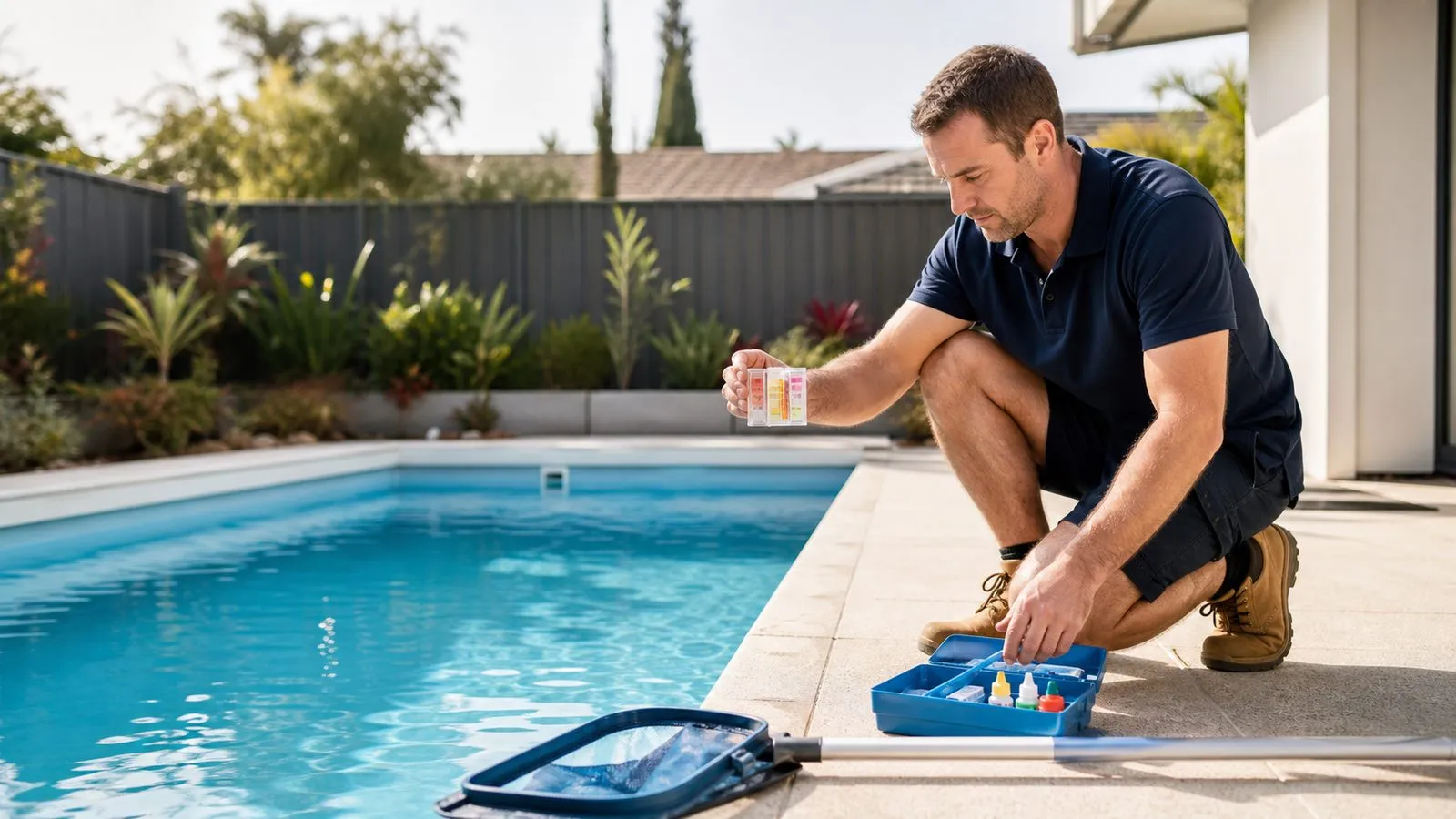
Are the tests measuring the same thing?
When a home test and a pool shop report disagree, first compare the test names, units and sampling times. Free chlorine, total chlorine and a chlorinator output percentage are not interchangeable readings. A result collected yesterday before treatment is not directly comparable with one collected today after circulation and dosing. Write those differences down before deciding which instrument is wrong.
Look at the labels on the kit and the report rather than remembering their colours. Some comparators combine several tests on one block, while strips use multiple pads with separate reading instructions. A blue or yellow patch alone does not identify the measurement. If a result is outside the printed scale, record it as outside range instead of inventing a value beyond the chart.
For a Pakenham pool owner, a useful first response is often to repeat a well-controlled sample and bring the kit instructions to the service discussion. Buying a stronger chemical or changing the chlorinator setting before resolving the measurement problem can create a second problem. Reliable testing begins with knowing what was actually measured.
| You are comparing | Why it may differ | Next check |
|---|---|---|
| Free and total chlorine | Different measurements | Match parameter names |
| Test and output percentage | Water measurement versus equipment setting | Keep separate records |
| Fresh and stored sample | Different handling and elapsed time | Repeat with comparable samples |
| Two colour readings | Timing, lighting or reagent condition | Repeat kit procedure exactly |
Take a sample that represents the pool
Use the sampling method specified for your test kit or by the testing service. Collect away from obvious local influences such as a return jet or a recent chemical addition, and avoid scooping only surface debris. Rinse a suitable sample container as instructed. Do not reuse a bottle that contained cleaning products, drinks or unknown chemicals because residue can affect the result.
Record where and when the sample was taken, whether the circulation was operating and any recent treatment. If a chemical has just been added, follow its instructions about circulation and waiting before testing. A sample collected from a poorly mixed area may say more about that location than about the overall pool. Testing immediately after treatment is not a shortcut to confirming the final condition.
If you are taking water elsewhere for testing, ask that service how they want the sample collected, stored and delivered. Do not leave it in a hot car while running errands. Some measurements change with storage conditions and elapsed time. Note the collection time on the container or your phone so the person testing it can interpret the result with the right context.
Check the kit before trusting the colour
Look at the expiry information and storage instructions for strips and liquid reagents. Heat, sunlight, moisture and contamination can affect test materials. A kit stored beside a sunny window or in a hot equipment enclosure deserves closer scrutiny, even if plenty of reagent remains. Replace suspect materials with the correct products for that kit rather than mixing brands or borrowing an apparently similar bottle.
Inspect the test cell for cloudiness, staining, scratches and residue. Follow its cleaning instructions and use the correct fill mark. The sample volume and reagent quantity work together; an approximate fill is not always good enough. Keep caps with their original bottles and avoid touching tips to the sample, which can carry contamination back into the reagent.
Read the result in the lighting and timing specified by the manufacturer. Do not compare a wet strip after it has been lying on the paving for several minutes. Do not use a phone photo as a precise colour meter: camera exposure, screen settings and reflected sky can shift colour. A photo can document the process, but it does not replace the kit's reading method.
Separate water chemistry from machine settings
A chlorinator output setting describes how the device is commanded to operate. It does not prove the chlorine concentration in the water. Production also depends on conditions such as operation, water flow and the device's own limits. The correct way to understand the water is to test it with an appropriate method and interpret that result alongside equipment information.
Similarly, a controller's salt display and an independent salt test may use different methods or respond differently to conditions. Record the exact display, model and current water temperature if available. Consult the device manual before assuming a warning means more salt is required. Adding salt on the strength of an unexplained display can overshoot the actual requirement.
Keep measured values and settings in separate columns in your notes. For example, write water test result beside its units and chlorinator setting beside the display value. This prevents a family member from copying the wrong number into a dosing conversation. It also lets a technician see whether a setting changed before the water result changed or afterwards.
Understand the relationships without chasing numbers
Pool chemistry is a set of related measurements. pH describes one aspect of the water's condition; total alkalinity relates to its resistance to pH change. Calcium hardness and stabiliser are different again. Changing one product can affect more than the parameter you intended to adjust. That is why a full treatment history is often more useful than a single isolated reading.
Use target ranges appropriate to the surface, sanitiser and equipment, supported by their product guidance. A generic internet chart may not describe your combination. Ask the technician to explain which target applies and why. Keep that explanation with the report so you are not comparing future results against a different chart each week.
Avoid repeatedly dosing in opposite directions to chase small variations that may come from the testing method. First establish that the variation is real and meaningful. The kit's resolution, reading method and sample conditions all matter. If a result changes dramatically without an obvious cause, repeat the measurement correctly or seek independent testing before treating the number as a confirmed change in the pool.

How can you resolve conflicting readings?
Start with a fresh sample and repeat the same method correctly. If the repeated result differs markedly, inspect the procedure, reagents and sample handling. If it agrees, compare with a second suitable method using samples collected under comparable conditions. Keep both results rather than discarding the one you dislike. A disagreement is information about the process, not permission to choose the more convenient number.
Tell the testing service exactly which kit you used and how the sample was handled. Take the reagent names, expiry details and a photograph of the kit instructions. Ask whether the test is suitable for the sanitiser and recent treatment products. Some tests have interferences or range limits that require a specific procedure. Do not invent a dilution method or extra reagent step from a different kit's instructions.
Agree on the next measurement that will resolve the uncertainty. That might be a fresh on-site sample, a correctly maintained instrument or a kit-specific interference check performed by someone competent. The important point is to stop changing several things at once. A controlled comparison can identify a sampling or procedure issue that repeated chemical purchases never will.
Read a report as a record of a particular moment
A water report describes the sample tested at that time. It is not a promise that the pool will remain unchanged until the next visit. Keep the collection and testing times, recent treatments, cover use and swimming activity alongside it. This makes later changes understandable and helps distinguish an equipment problem from a change in demand.
Ask for actual measured values and units, plus any limitations such as an off-scale result or an estimated pool volume. A treatment recommendation based on an uncertain volume should carry that uncertainty. If the report recommends a product, confirm what the product is intended to change and what needs to be retested after use. Do not assume every item on a printout is an urgent purchase.
Compare trends only when the measurement conditions are reasonably consistent. A morning sample after a covered night and an afternoon sample after swimming may differ for understandable reasons. Keep enough context to interpret the difference. The goal is a dependable routine that detects meaningful changes, not a spreadsheet full of numbers collected in unrelated ways.
Work through a conflicting-result example
Hypothetical example: a homeowner in Cardinia Lakes reads a test strip at home, then drives a water sample to a testing service later in the day. The report differs. During the conversation, they realise the strip was read after the recommended time and the sample bottle sat in the car during shopping. Neither result should become the basis for an aggressive correction without a better comparison.
The useful response is to collect a fresh sample using the agreed procedure and repeat the home test with sound materials and correct timing. The homeowner records the kit model and recent additions. The testing service explains how promptly the transported sample should arrive. This makes the next pair of readings more comparable and identifies whether a real disagreement remains.
If the results still conflict, the technician can investigate method suitability or interference with much better evidence. The homeowner has not altered the water repeatedly while trying to make two numbers agree. They have separated a measurement question from a treatment question, which is the decision that prevents unnecessary work.
Avoid the common measurement traps
One trap is interpreting a faded, bleached or unusual colour as a simple low reading. Some test methods can behave unexpectedly outside their range or in the presence of interfering substances. Follow the kit's troubleshooting guidance and seek help with a result that does not fit the scale. Do not respond automatically with more sanitiser.
Another trap is assuming an electronic instrument cannot be wrong. Instruments still require the correct method, clean sample cells and any specified calibration or checks. Ask how the result was obtained if it conflicts with other evidence. The purpose is to understand the method, not to dismiss a service provider or declare your own kit superior.
A third trap is averaging results from different parameters or unsuitable methods. An average of a free chlorine value and a total chlorine value has no useful meaning. Likewise, a controller percentage does not belong in an average with a concentration. Label every reading before comparing it. Most household logs improve immediately when they separate units, method and equipment settings.
Build a testing routine you can sustain
Choose a kit that measures the parameters needed for your pool and that you can use consistently. Ask for a demonstration and repeat the method yourself while someone can correct mistakes. Store the materials as directed and keep a note of expiry or replacement dates. A simpler correctly used kit is more useful than a complicated one left unopened.
Agree when to test under the normal routine and what events require an additional check. Changes in water appearance, significant use, treatment or equipment operation should be reported with context. Do not use this guide or a checklist completion as a swimming clearance. If water condition is uncertain, resolve it with suitable testing and assessment before use.
For a service enquiry, send the conflicting readings with their units, methods, sample times and recent product additions. Attach a photo of the kit label and equipment display where relevant. Ask for help resolving the disagreement before asking for a quantity to add. That produces a more useful answer and leaves you with a repeatable way to check the pool next time.